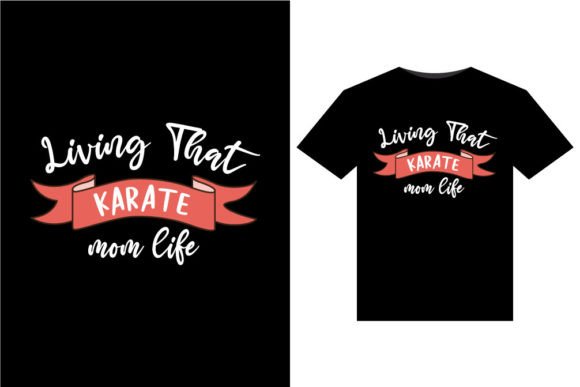
Living That Karate Mom Life T-Shirts
As someone who’s digitized, stitched, and sold hundreds of embroidery designs—ranging from delicate baby onesies to bold boutique sweatshirts—I approached Living That Karate Mom Life T-Shirts with a mix of curiosity and caution. It’s not just another “mom life” graphic. It carries attitude, rhythm, and a very specific kind of warmth—the kind that lands perfectly on a custom-embroidered tote bag handed out at a kids’ karate studio open house.
A Design That Breathes With the Stitch
First impression? Clean, confident, and intentionally uncluttered. The illustration leans into expressive line work and balanced negative space—not surprising, given it’s labeled as 100% vector and fully resizable. That matters. When I scaled it down for a 3-inch hoop on a baby kimono sleeve, the core shapes held up: the stance, the belt knot, the subtle curve of the smile. No pixelation, no jagged edges—just crisp geometry ready for digitizing.
What makes Living That Karate Mom Life T-Shirts feel *embroiderable* isn’t just its vector foundation—it’s how the composition invites stitch interpretation. There’s no dense fill-stitch jungle or micro-lettering that’ll vanish under thread. Instead, you get strong outlines, intentional breaks in line weight, and a focal point (the karate pose) that reads clearly even at 2.5 inches tall. That’s rare in graphics marketed broadly as “T-Shirt Designs.” Most aren’t built with stitch density or fabric drape in mind. This one is.
Where It Shines—and Where to Pause
I tested Living That Karate Mom Life T-Shirts across three real projects: a medium-weight cotton apron for a martial arts-themed café, a lightweight organic cotton onesie for a new dojo parent group, and a structured twill cap for a small-batch Etsy shop. Here’s what stood out:
- Tote bags & aprons: Perfect scale and contrast. The design’s vertical emphasis anchors well on the front panel without overwhelming. Satin stitch works beautifully for the belt detail; running stitch adds subtle motion to the sleeves.
- Baby items & sweatshirts: Holds clarity on textured fleece and brushed cotton—but only with proper cutaway stabilizer underneath. On ultra-thin fabrics, I’d reduce stitch density slightly or add a light tear-away layer on top during stitching.
- Caps & curved surfaces: Works best centered above the bill—not wrapped around the crown. The clean silhouette avoids distortion, but avoid placing it too low where the curve tightens.
It’s not ideal for high-detail applications like embroidered patches meant for iron-on application (no backing layers included), nor for tiny hoops under 2 inches unless simplified first. And while the vector file gives flexibility, remember: resizing doesn’t automatically optimize for stitch count. Always re-digitize or adjust density for your machine’s capabilities and fabric type.
Real Impact on Your Craft Business
For Etsy sellers and small shop owners, Living That Karate Mom Life T-Shirts delivers more than visual appeal—it builds trust. Customers recognize authenticity when they see a design that looks handmade, not mass-printed. That slight asymmetry in the stance? That intentional looseness in the belt ends? It reads as human, not algorithmic. That translates directly to higher perceived value in personalized gifts and boutique merchandise.
I’ve seen similar themes fall flat because they’re overly literal or cutesy. This one walks the line: proud but playful, strong but soft. It fits seamlessly into holiday embroidery collections (think Mother’s Day bundles with matching tea towels), nursery decor sets, or even wedding gifts for martial artist couples. And yes—it works just as well on dark fabric, especially with matte black or navy thread. Just test contrast first using a grayscale mockup.
Practical Notes Every Embroidery Designer Should Keep Handy
Before stitching your first Living That Karate Mom Life T-Shirts project, do these five things:
- Test on scrap fabric—especially if using stretchy knits or textured weaves. Watch how the lines hold up after washing and drying.
- Check thread color contrast against both light and dark backgrounds. A warm charcoal works better than pure black on heather grey.
- Review stitch density. If your machine flags it as “high density,” reduce fill coverage by 5–10% for breathable fabrics.
- Confirm hoop size compatibility. While the vector scales infinitely, your embroidery file must match your machine’s maximum hoop dimensions.
- Verify licensing. Since this is listed as a digital embroidery file for commercial use, double-check whether resale of finished embroidered products is permitted—and whether attribution is required.
Also worth noting: this isn’t an applique design. There are no layered fabric suggestions or reverse-cut guides built in. So if you’re planning a mixed-media look (e.g., satin-stitched outline + fabric belt insert), you’ll need to adapt manually.
Final Thought: A Design That Fits the Moment
Living That Karate Mom Life T-Shirts succeeds because it understands its audience—not just moms, but makers. It respects the craft: no hidden traps, no overpromised detail, no assumptions about your machine or fabric. It’s a solid, adaptable, emotionally resonant starting point for custom apparel, embroidered patches, kitchen towels, and small-batch merchandise.
Use it thoughtfully—with the right stabilizer, smart thread choices, and realistic expectations—and it won’t just look good stitched. It’ll feel earned. Like the best handmade product should.