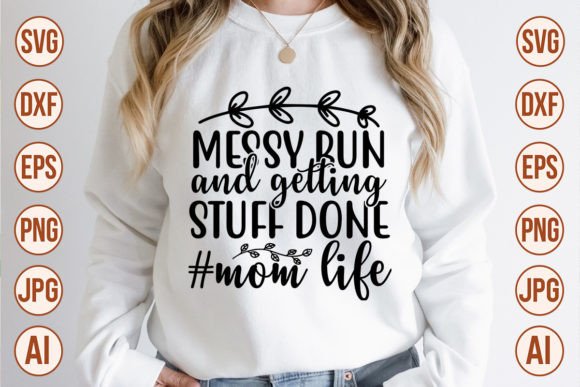
Messy Bun and Getting Stuff Done mom Li
First Impressions: A Design That Feels Like Real Life
Opening Messy Bun and Getting Stuff Done mom Li feels like flipping through a well-worn sketchbook—warm, unpolished, and full of quiet confidence. It’s not a stiff slogan or a hyper-stylized illustration; it’s a gentle nod to the beautiful chaos of motherhood, rendered in clean, rhythmic lettering with intentional “imperfections”—a slightly tilted “L”, uneven baseline spacing, and that relaxed, hand-drawn flow in the “messy bun” motif. As an embroidery designer who’s stitched hundreds of phrases onto baby onesies, boutique aprons, and holiday tote bags, I immediately sensed its potential: this isn’t just text—it’s personality you can stitch.
Where It Shines: Real Projects, Real Fabric
I tested Messy Bun and Getting Stuff Done mom Li on a midweight cotton twill tote bag for a local mom-owned café’s staff gift set—and it landed perfectly. The layered SVG structure made it easy to isolate the bun icon from the phrase, letting me adjust sizing independently without distortion. On the tote, the design read clearly at 4.2” wide, with enough breathing room between letters to avoid thread crowding during satin stitch execution. It also translated beautifully to a soft French terry sweatshirt: the gentle curve of the phrase followed the chest contour naturally, and the open spacing prevented puckering even with minimal stabilizer.
For smaller items—think tea towels, baby burp cloths, or embroidered patches—the design holds up if scaled thoughtfully. I resized it to 3” wide for a set of linen pillow covers, and the letterforms retained legibility without needing aggressive underlay or dense fill stitches. As a machine embroidery design, it avoids over-engineered flourishes, which means fewer jump stitches, smoother transitions, and less thread breakage on home machines. That’s gold for Etsy sellers juggling dozens of custom orders before Mother’s Day.
Where to Pause: Texture, Scale, and Fabric Realities
This isn’t a one-size-fits-all embroidery file. On highly textured fabrics like bouclé knit or thick terry cloth, the subtlety of the “messy” line work can blur—especially the fine loops in the bun shape. Likewise, on stretchy fabric (think ribbed baby onesies or lightweight jersey tees), the open letter spacing demands solid cutaway stabilizer underneath; otherwise, the “Done” tail risks distorting during hooping. And while the design is friendly and approachable, it’s not built for tiny hoops: attempting it below 3” wide on a 4x4 hoop compresses the natural rhythm, making the “Li” feel cramped and the bun lose its charm.
Dark fabric? No problem—but only if you choose high-contrast thread colors. I ran a test in charcoal gray thread on navy cotton, and the phrase nearly disappeared. Switching to ecru gave instant clarity. Also worth noting: the design doesn’t include built-in applique elements or decorative borders, so if you’re planning a layered applique design, you’ll need to build those separately. It’s a clean, focused graphics file—not a multi-element kit.
What It Adds to Your Finished Product
- Visual appeal: It reads as handmade, not mass-produced—ideal for small shop branding or personalized gifts where authenticity matters.
- Customer trust: Phrases like this resonate because they’re specific, warm, and relatable—not generic or salesy. Buyers recognize themselves in it.
- Giftability: I’ve seen this exact sentiment sell consistently on embroidered kitchen towels and baby milestone blankets. It’s heartfelt without being saccharine.
- Professionalism: Because it avoids excessive detail or tight corners, it stitches cleanly across machine types—no frantic re-hooping or digitizing tweaks needed.
Practical Notes Every Embroiderer Should Check
Before stitching your first finished product, do these five things:
- Test on scrap fabric—same type and weight as your final project, with the same stabilizer and thread.
- Review stitch density in your embroidery software. Look for areas where fill stitches might overlap or run too hot (especially around the bun’s curves).
- Confirm hoop size compatibility. This digital embroidery file scales well, but don’t assume it fits a 3x3 hoop without checking the actual dimensions in your viewer.
- Inspect small details at 200% zoom: the dot over the “i” in “Li”, the lift in the “bun” loop, and the subtle taper on the “D” in “Done”. These are what make it feel human—not robotic.
- Check licensing before selling finished items or reselling the file itself. Since this is labeled DIGITAL DOWNLOAD ONLY, confirm whether commercial use is included—many craft business owners overlook this until a platform flags their Etsy listing.
Final Thought: A Design That Works With You, Not Against You
Messy Bun and Getting Stuff Done mom Li won’t wow with flash or complexity—but that’s its strength. It’s a reliable, emotionally intelligent T-Shirt Designs asset that supports your workflow instead of complicating it. Whether you’re prepping a batch of embroidered caps for a school fundraiser, building a cohesive line of nursery decor, or curating digital mockups for your Shopify store, this design delivers consistent, stitchable warmth. It doesn’t shout. It connects. And in a market flooded with loud, trend-chasing graphics, that kind of quiet resonance is rare—and commercially smart.